






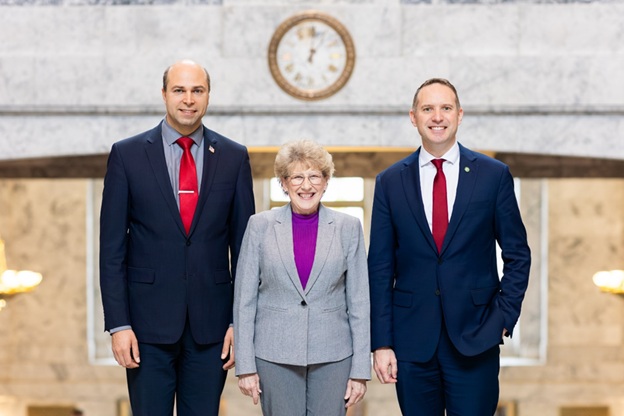
7th District lawmakers, from left: Rep. Andrew Engell, R-Colville, Sen. Shelly Short, R-Addy, and Rep. Hunter Abell, R-Inchelium.
OLYMPIA — In a 2026 legislative session overshadowed by passage of an income tax, area lawmakers scored key victories for North-Central and Northeastern Washington, including restoration of wildfire funding and legislation addressing the needs of the state’s largest legislative district.
Lawmakers serving Washington’s 7th Legislative District say it was a tough session nevertheless, marked by major floor fights over the income tax, skyrocketing state spending and expansions of government authority favored by the Democrats who hold the majorities in the state House and Senate. The 60-day session ended March 12 in Olympia, and has been followed by weeks of bill-signings and speculation about long-term consequences. The local lawmakers have returned from Olympia and have been meeting with constituents at a series of town hall meetings across the district.
“This session was one of the most consequential in our state’s history, and some elements still have not fully played out,” said Sen. Shelly Short, R-Addy. “Challenges to the income tax, whether in court or on the ballot, will keep that issue in play for some time. This year’s budget sets us up for big deficits in the 2027-29 biennium. And the main thrust of this year’s legislation seemed to be government’s insatiable desire for money and building up the power of the Olympia bureaucracy.
“Yet we can look back on the session and see we accomplished important things for the 7th Legislative District. We won a crucial victory on wildfire funding, and our delegation worked together to pass significant legislation for our district. Though the state as a whole continued down the wrong path this year, on the local level we managed to accomplish quite a bit.”
The 7th District lawmakers worked as a team, with freshman legislators Hunter Abell, R-Inchelium, and Andrew Engell, R-Colville, representing the district in the House. Meanwhile Short served as a senior member of Senate leadership in her 18th legislative session, acting as floor leader for the Senate Republican Caucus. The lawmakers worked together on legislation and in some cases sponsored companion bills in their respective chambers to increase chances of passage.
“Serving a district as large and diverse as the 7th requires constant coordination and a shared focus on results,” Engell said. “I’m proud of how our delegation worked together this session to move legislation that reflects the realities of rural communities and delivers practical solutions for the people we represent. That kind of teamwork matters, especially in a year when it took persistence and discipline to get meaningful policy across the finish line. We stayed focused on our district, and that made a difference.”
Wildfire funding is major victory
This year’s session posed a question: Would the state continue its innovative wildfire prevention program? In 2021, under the leadership of former Lands Commissioner Hilary Franz, the state began a coordinated effort to reduce the severity of wildfires, combining best practices in firefighting and forestry. The effort has become one of the state’s biggest success stories, dramatically reducing the smoky skies of a decade ago. The eight-year, $500 million program has allowed the state to hire bigger fire crews, put air fleets on standby, invest in new fire-detection technologies and invest in forest-thinning operations to reduce overgrowth on 1.2 million acres of public and private timberlands. Last year just 251,000 acres burned in Washington, about an eighth of the damage seen in the neighboring state of Oregon, where no such program is in place.
Yet last year’s Legislature dealt a blow to the program when it cut funding by $65 million, threatening the state’s ongoing investment in forest management. Short sponsored Senate Bill 5893 to restore funding and joined a bipartisan chorus of lawmakers seeking to keep the program on track. Their efforts paid off in the final budget bill, which restored $60 million to keep the program whole. Short notes that the effort is of particular importance to the heavily forested 7th District, where fire remains a constant threat.
Legislation focuses on district needs
Meanwhile, the lawmakers passed a half-dozen bills advancing the interests of the sprawling district, which encompasses all or part of seven North-Central and Northeastern Washington counties and covers approximately 20 percent of the state’s land area. The rugged rural nature of the district was reflected in the legislation they introduced, covering everything from wildlife management to the particular difficulties faced by rural hospitals.
“In a session where many proposals never made it across the finish line, passing multiple bills focused on the needs of our district is something we can take price in,” Abell said. “Each of these measures was grounded in real challenges facing our communities, and they reflect a commitment to thoughtful, disciplined policymaking that respects both the law and the people we serve. These are no abstract policy discussions. They are targeted solutions shaped by the realities of rural life, and they demonstrate what can still be accomplished with focus and purpose.”
Four bills sponsored by Abell won passage this year. They are:
House Bill 1541, which strengthens Washington’s Veterans Affairs Advisory Committee by requiring that members reflect a broad array of perspectives and experiences. The bill is dubbed the Jim Judd Memorial Act, an Inchelium man remembered for his dedicated advocacy for veterans’ causes.
House Bill 2158, which modernizes Washington’s notary laws by expanding the use of remote notarization. The bill allows certain documents, oaths and acknowledgements to be completed using secure communication technologies, while maintaining strong identity verification and recordkeeping requirements. The bill improves access to notarial services, a matter of particular importance to rural districts where travel can be a barrier.
House Bill 2179, which clarifies retirement eligibility for port employees who already participate in federal or union-sponsored retirement programs. The legislation aims to prevent railroad workers at the Port of Pend Oreille from having to make contributions to the state retirement system, as would be required by a recent legal reinterpretation by the state Department of Retirement Systems. The measure affects other port districts as well.
House Bill 2239, which allows landowners to create small family burial grounds on privately owned property, allowing families to honor loved ones in a deeply personal way, while setting common-sense rules to protect public health, property rights and future property owners.
Engell passed two bills this session. They are:
House Bill 2113, which allows advanced practice registered nurses and physician assistants to supervise diagnostic imaging and other radiology services. The measure provides greater flexibility for hospital staffing, allowing qualified staff to provide services at rural hospitals without the need for physician supervision.
House Bill 2114, which waives fees for replacing defective license plates. Peeling paint appears to be a particular problem in Eastern Washington, Engell notes. The bill eliminates approximately $80 in replacement fees when plates are less than two years old, and allows the Department of Licensing to eliminate fees for defective plates between two and five years old.
Engell also succeeded in amending the income tax bill, Senate Bill 6346, offering one of just two Republican amendments accepted by Democrats during an unprecedented 25-hour debate in the House. Engell’s amendment extends a tax break for hospitals to other medical providers.
Bills that failed to advance this year included an Abell proposal for a Capitol campus memorial to Washington victims of the Global War on Terror (House Bill 2514), an Engell proposal to limit hospital charity care requirements to Washington state residents (House Bill 2250), and a Short proposal to exempt small school districts from cumbersome green-energy requirements for HVAC systems, aimed at reducing construction costs for the Selkirk School District in Pend Oreille County and others like it (Senate Bill 5941).
Also failing to advance was a proposal for comprehensive Eastern Washington wildlife management offered by Abell in the House (House Bill 2221) and Short in the Senate (Senate Bill 5960). The 7th District lawmakers say they will continue to pursue those ideas next year. In addition, Short plans to continue work next session on legislation to increase transparency in wildfire insurance scoring, as proposed this year by retiring Sen. Judy Warnick, R-Moses Lake, in Senate Bill 5928.