






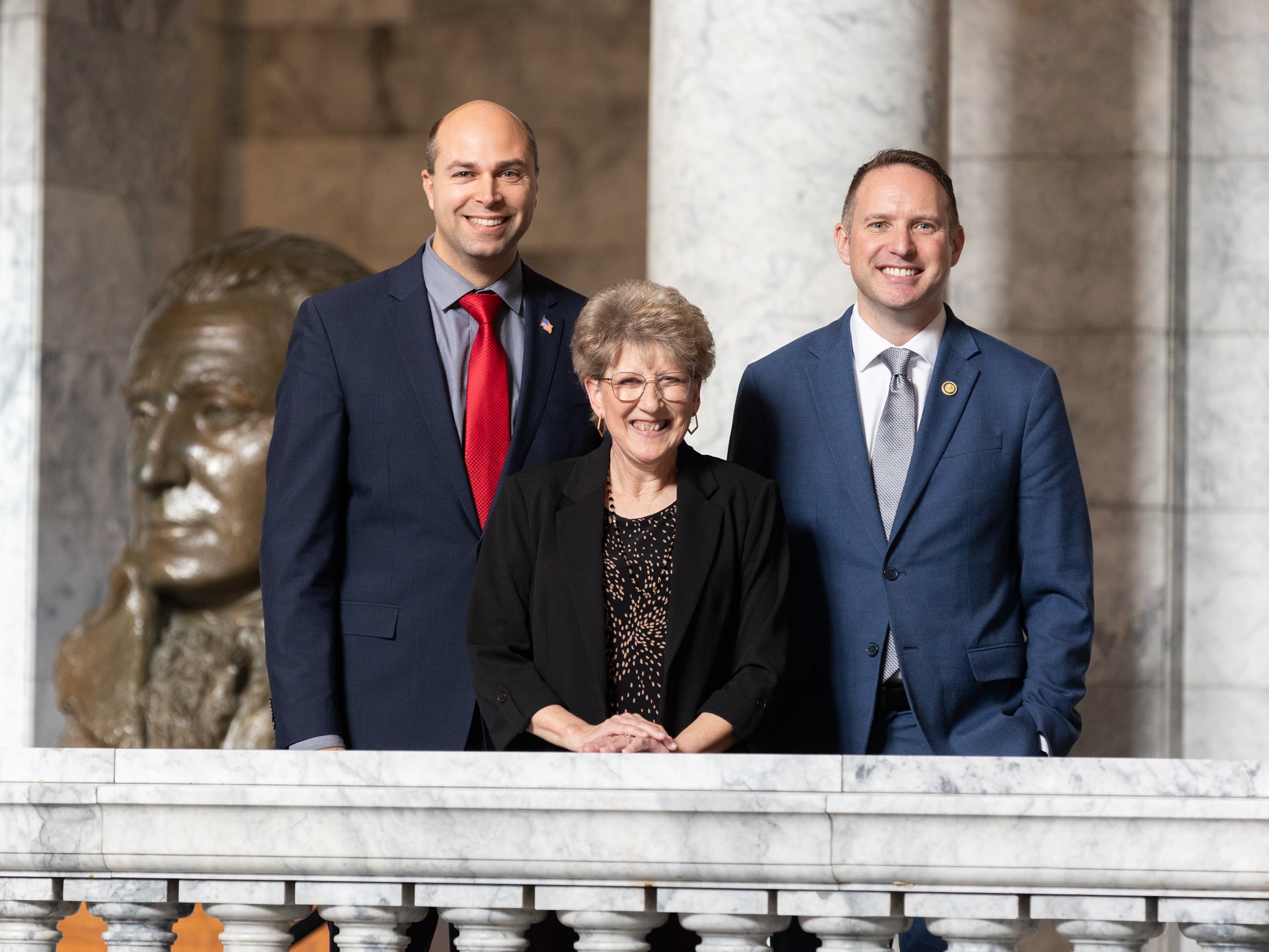
From left, Rep. Andrew Engell, R-Colville, Sen. Shelly Short, R-Addy, and Rep. Hunter Abell, R-Inchelium.
OLYMPIA – Wolves, wildfires, and the survival of small community hospitals are occupying the attention of 7th District lawmakers as the 2026 legislative session hits its stride in Olympia.
This year’s legislative session opened Jan. 12 and runs 60 days, with adjournment expected on or before March 12. The Legislature, under Democratic control, is considering big-picture issues that include an income tax, property tax increases and restrictions to the people’s right of initiative.
Meanwhile, 7th District lawmakers are pushing a coordinated agenda of bills reflecting the interests of the sprawling region they represent. Sen. Shelly Short, R-Addy, Rep. Hunter Abell, R-Inchelium and Rep. Andrew Engell, R-Colville, are working closely together, in some cases offering companion versions of bills in House and Senate to improve chances of passage.
“Our district is the largest and most rugged in the state, and that gives us a unique set of issues,” Short said. “By working together, we dramatically increase our influence.”
The legislative district covers Northeastern Washington and much North-Central Washington, including Ferry County, Okanogan County, Pend Oreille County, Stevens County, and parts of Chelan, Douglas and Spokane counties. Top issues for the district include:
- Wildfire prevention and forest health. A central issue for the district in this year’s budget negotiations is restoration of funding for the state’s comprehensive approach to wildfire issues. Since 2020, the state has combined comprehensive fire response and detection efforts with a program to remove overgrowth and other flammable material from state-managed and privately owned forests. The program already is achieving success in clearing the smoky summer skies over northeastern Washington, but the multi-year forest health program is at risk. Last year’s Legislature provided only $60 million of the $125 million required for the program in 2025-27. Short has introduced Senate Bill 5893 to appropriate the missing $65 million and keep the program on track.
Short also has introduced Senate Joint Memorial 8015, urging that federal efforts to reorganize wildfire protection programs be coordinated so that firefighting efforts are not negatively impacted during the 2026 fire season.
- Comprehensive management of ungulate species and predators. House Bill 2221, sponsored by Abell, addresses significant declines in wildlife population in the eastern third of the state, where wolf populations have rebounded and are no longer federally protected. The concept, forwarded by organized sportsmen’s and women’s groups in the district, requires the Washington Department of Fish and Wildlife to take a comprehensive approach to the wildlife management. When predation reduces populations of game species like deer, elk and moose by 25 percent or more, the department would be required to intervene for their protection within 60 days.
“For rural communities, healthy deer and elk populations are not abstract policy debates,” Abell said. “They support local economies, hunting traditions, tribal and nontribal subsistence and wildlife viewing. When herds decline, the state has a responsibility to manage predators responsibly and proactively, not wait until the damage is already done.”
Abell’s bill is scheduled for a hearing Friday, Jan. 30 in the House Agriculture and Natural Resources Committee. A companion version sponsored by Short, Senate Bill 5960, received a hearing Jan. 19 in the Senate Agriculture and Natural Resources Committee. More than 800 people signed on to the Legislature’s website to express support.
“It’s an idea whose time has come, and we are hoping this strong show of support from our part of the state will help us advance this bill this session,” Short said.
Meanwhile, Engell continues to press House Bill 1311, a measure he introduced last year to require the state to follow the lead of the feds in down-listing gray wolves from endangered to “sensitive” in areas where they have recovered, giving the state more flexibility in responding to predation threats.
- Preserving community hospitals. Engell is tackling a critical issue for the state’s rural hospitals with House Bill 2250, which reestablishes a Washington-state residency requirement for non-emergency charity care. Engell’s bill has received a hearing in the House Health Care and Wellness Committee. Short has introduced a companion bill in the Senate, Senate Bill 5959.The issue concerns a new interpretation of state law from the Department of Health allowing nonresidents to seek non-emergency charity care is a potential budget-buster for small community hospitals, Engell said. Already some hospitals near state borders are seeing a spike in out-of-state patients taking advantage of the policy. The bill would not affect access to emergency charity care.
“This is about fairness and sustainability,” Engell said. “Our hospitals are facing real capacity constraints and rising costs. Charity care resources should be focused on the communities they are intended to serve.”
- Retirement eligibility for port districts. The House Appropriations Committee has approved a measure sponsored by Abell eliminating a costly requirement that port district employees pay into multiple retirement systems. House Bill 2179 and its Senate companion, Senate Bill 5905, sponsored by Short, clear up a problem for the Port of Pend Oreille and other port districts where workers are already covered by federally regulated retirement systems and union-sponsored pension plans with defined benefits. The bills counter a recent reinterpretation of state law requiring the port employees to contribute to the Washington Public Employees Retirement System.“That interpretation would force workers to pay into two retirement systems at once, something they simply can’t afford,” Abell said.
Most bills face a Feb. 4 deadline for votes in policy committees if they are to remain alive for consideration in this year’s session. Measures necessary to implement the budget, including the wildfire appropriation measure, remain alive until adjournment.