






Note: The following e-newsletter was distributed to Sen. Shelly Short’s subscribers March 23, 2026. To subscribe to Sen. Short’s e-newsletters, click here.
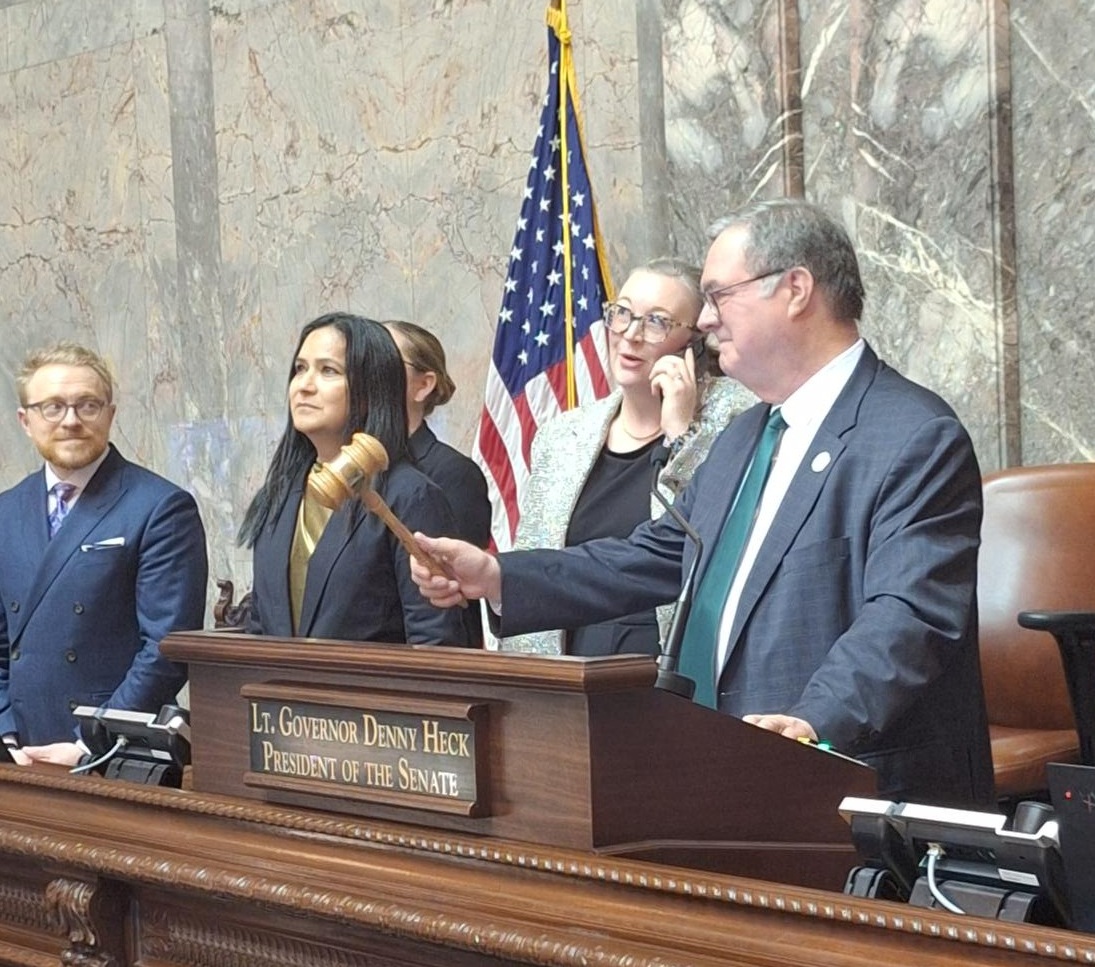
This year’s 60-day legislative session started Jan. 12 and adjourned with the rap of gavels in the Senate and House on March 12. Above, Lt. Gov. Denny Heck ends the session in the Senate at precisely 8:23 p.m.
Dear Friends and Neighbors,
 We’ve just finished our 2026 legislative session in OIympia, and I think it is fair to say this was one of the most consequential in our state’s history. I don’t mean that in a good way. What happened still is hard to believe.
The Legislature passed an income tax. For nearly a century, advocates of higher taxes and spending have been trying to convince Washington voters that an income tax would be good for them. And it never worked, because the people are smarter than that. This year our majority Democratic colleagues gave up trying, and they passed an income tax without seeking voter consent. Now they are daring the rest of us to do something about it.This historic betrayal may be the one thing we remember when we look back on this year’s session. But there was so much more. This session continued the worrisome trends that have brought our state to a tipping point – Skyrocketing state spending. Unsustainable budgeting. Big new taxes to prop it all up. Bills to enhance the power of government over the people. Legislation that will make life in this state less affordable.
There were a few bright spots this year, including restoration of wildfire-prevention funding that was cut in last year’s budget. I also want to give a shoutout to my seatmates for working to pass legislation important to the 7th District. But most of our victories this year involved bills we stopped, not bills we passed, and any of those could return next year. This was the eighth year of one-party control of the state Legislature, and under “progressive” leadership, our state continues to fall behind.
First the good news —
Legislature restores wildfire prevention funding
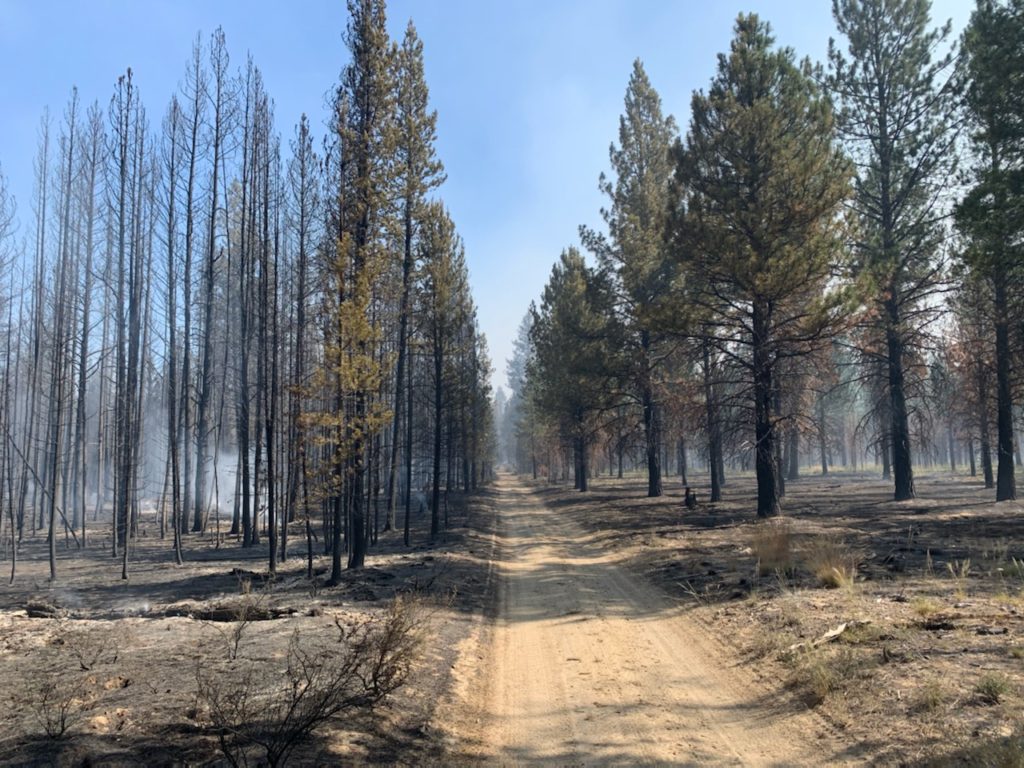
This photo from the Deschutes National Forest in Oregon offers a dramatic illustration of the effect of forest management on wildfire resiliency. Unmanaged forest to the left was charred in the 2020 Rosland Road fire; managed forest to the right survived largely unscathed.
Remember those smoky skies we used to see about 10 years ago at the peak of summer fire season? We still get them, but they’re nothing like they used to be, thanks to the innovative wildfire prevention and forest health program Washington launched in 2021 with House Bill 1168. By combining best practices in forestry and firefighting, we are getting to fires faster, containing them sooner and reducing their severity. We have fire crews on standby and we are positioning air fleets across the state. We’re investing in new technologies to detect fires and we are thinning forests to reduce the overgrowth that leads to deadly crown fires.
 We call this the 1168 program, and it is one of our state’s biggest success stories. It costs us $125 million every two years, and we certainly are seeing a return. Research shows that every dollar we spend on prevention avoids $8 in disaster and recovery costs. But this effort was thrown into doubt when last year’s Legislature slashed funding in half. Concerned lawmakers on both sides of the aisle worked together this session to raise awareness of the importance of this investment. I sponsored Senate Bill 5893 to restore funding, and I am pleased to report that this year’s Legislature stepped up with $60 million to keep this effort on track. This was one of this year’s rare bipartisan successes, and it showed what we can accomplish when we don’t allow political differences to get in our way.
Another thing that makes me proud is the way our 7th District delegation has worked as a team to pass legislation focused on our district. Let me credit my House seatmates Hunter Abell and Andrew Engell for advancing several important bills to the governor’s desk, including Abell’s House Bill 2179, which eliminates a pension snarl at the Port of Pend Oreille and elsewhere. Other bills we sponsored jointly in the House and Senate included measures to reduce the burden of charity care on rural hospitals and bring comprehensive wildlife management to our region of the state. We’ll continue working on these issues next year.
My biggest personal disappointment this session was the failure of a bill requiring greater transparency by insurance companies in the way they score wildfire risks, an enormous issue for rural North-Central and Northeastern Washington. I was a co-sponsor of Senate Bill 5928, which passed the Senate but did not receive a vote in the House. Although we didn’t get it across the finish line, we laid the groundwork for more work on this bill during the interim.
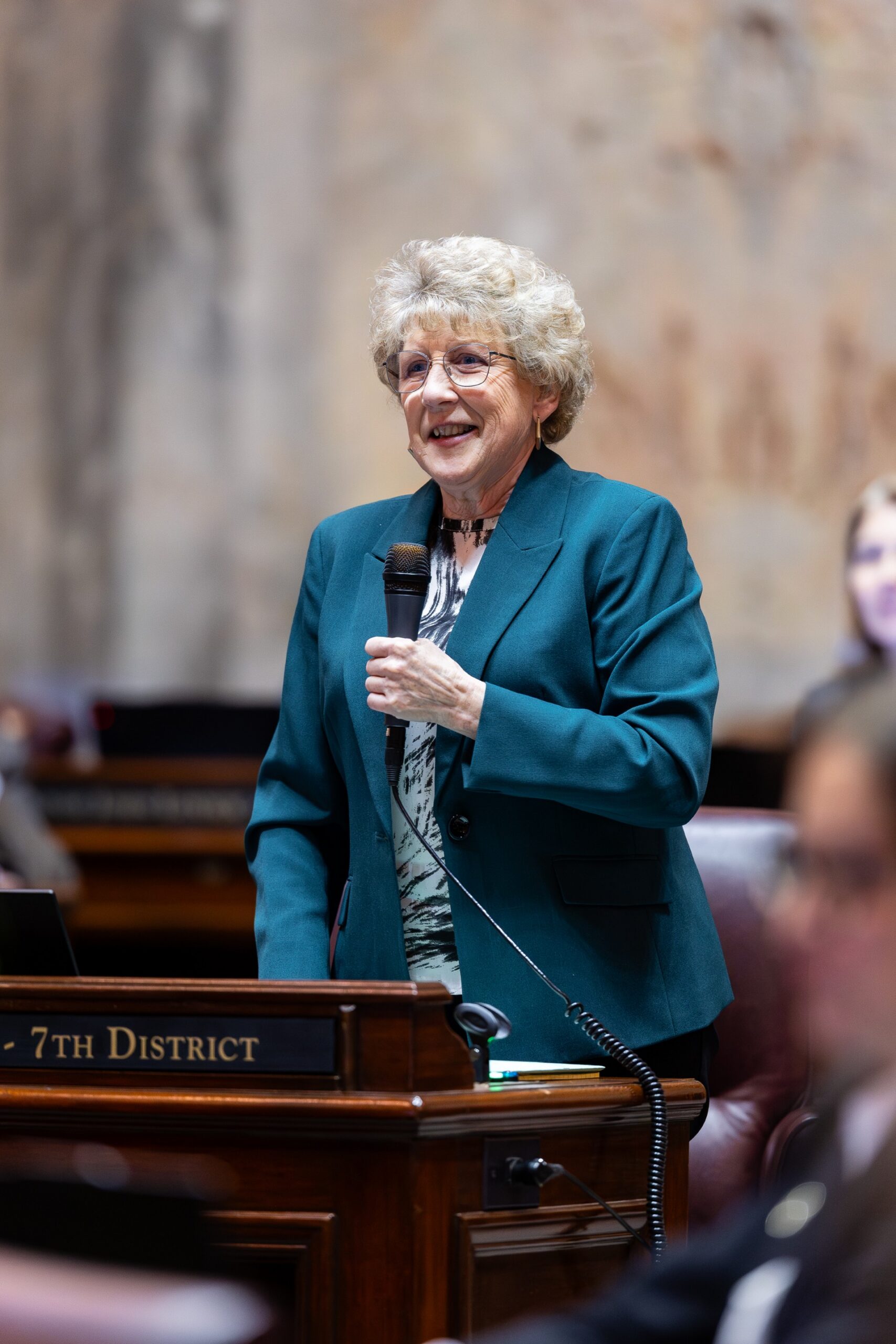
As floor leader for the Senate Republican Caucus, I am responsible for parliamentary motions and the flow of business during Senate floor sessions. I play a strategic role in floor debate, and I am honored my colleagues have elected me to this position.
Now the bad news —
An unconstitutional income tax

“First they came for the millionaires…” Public opposition to this year’s income tax legislation reached record levels as 118,421 individuals signed in to the Legislature’s computer system to register their opposition. Democrats declared the opposition must be fake, blamed it on bots and passed the bill anyway.
Washington has voted against an income tax ten times since 1934, and you would think Olympia would get the message by now. Unfortunately, majority Democrats have decided the problem isn’t the tax, it’s that the people have the right to vote on it. Their income tax bill, Senate Bill 6436, is part of a strategy to cut the people out of the loop and shift the battle from the ballot to the courts.
Our colleagues are deliberately flouting a 1933 Supreme Court ruling that says a graduated income tax requires a constitutional amendment and therefore a public vote. Of course it will be challenged, but that’s part of the plan. They are counting on today’s more-liberal Supreme Court to overturn that 93-year-old ruling and allow this income tax to be forced on the people without their approval.
For now, this 9.9 percent tax is targeted at high earners. It also snares small business owners who report gross receipts on their personal taxes. But if this income tax sticks, it would be so easy to expand the income tax to the rest of us that it would be the end of responsible budgeting in Olympia. Rather than setting priorities and making difficult decisions about the things government really needs to do, the Legislature would be able to take the easy way out and just raise taxes. Nor is there any guarantee that money would be spent on programs people hold dear, like education or services for the disabled. We’re already seeing an exodus of businesses and job creators from this state, and if anything positive comes of this, it will be to teach our colleagues how fragile our prosperity really was.
A bloated state budget
So why are we seeing this push for an income tax? It’s because our colleagues have spent the state into the hole and want to keep right on spending. This year’s budget continues the trend. It increases total spending for 2025-27 to $80.2 billion, double our budget of ten years ago. Spending has risen twice as fast as the median family income, and this rapid growth of state government is getting us in serious trouble.
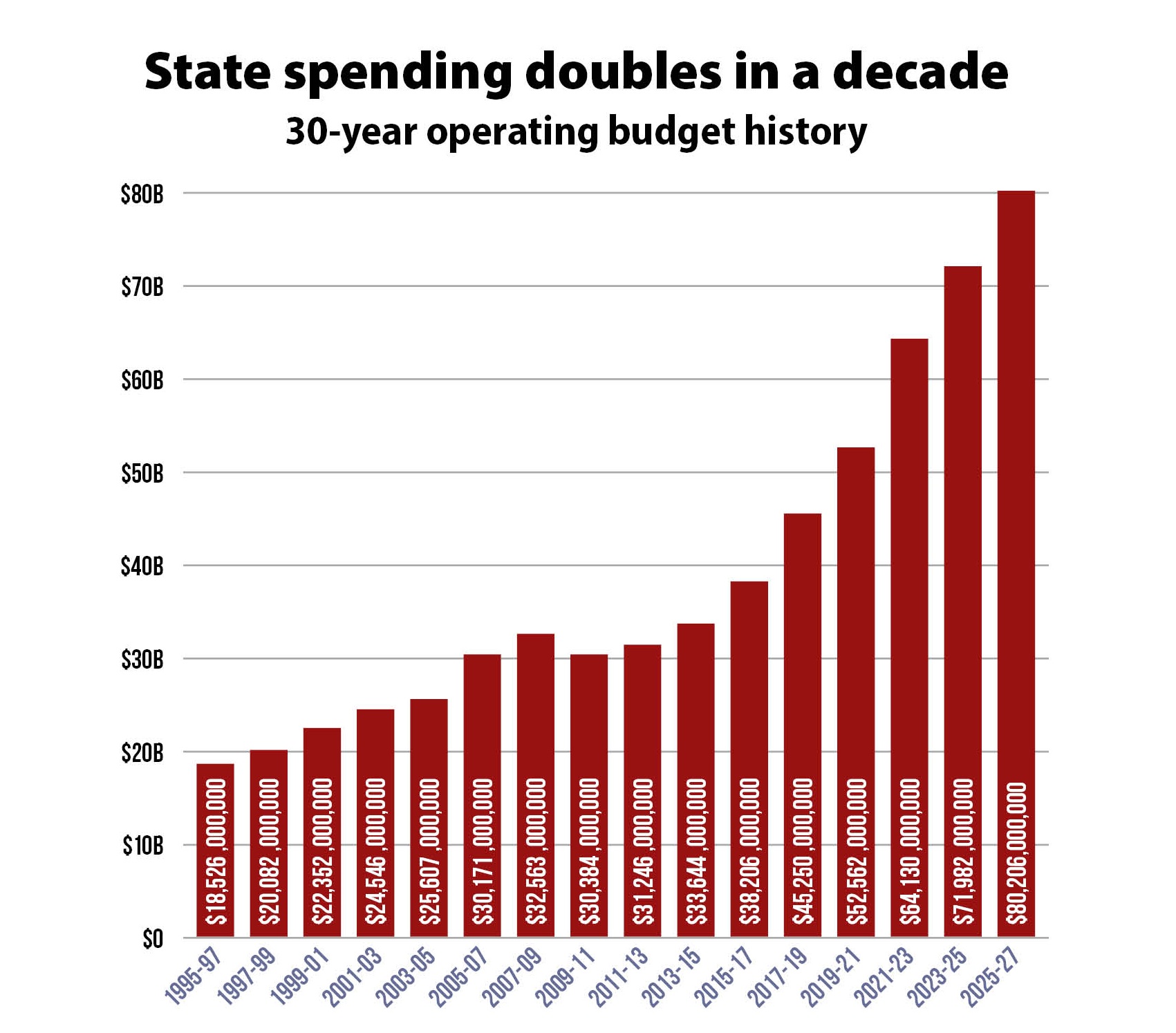
Last year this unchecked spending put the state in a deficit, and the only solution our colleagues were willing to consider was a $12 billion tax increase, the largest in state history. Now comes the income tax. About half the money it would generate is already spoken for, to sustain all the new spending in the current budget. Still it won’t be enough.
The only way next year’s budget will balance is if our colleagues can keep spending increases to 2.8 percent. That’s not realistic, given that the typical budget growth under current leadership is 15 percent. If current rates of spending continue, we are looking at a deficit next year of $7 billion to $10 billion. How long do you think it will take for Olympia to raise taxes again?

More power for government
The big trend in legislation this year appeared to be more power for government at the expense of the people. Prime examples include:
OVERRIDING SHERIFF ELECTIONS: Senate Bill 5974, the “anti-sheriff bill,” gives an unelected board appointed by the governor the ability to remove elected county sheriffs from office. The measure aims to quash independent thinking on policing procedures, cooperation with federal immigration officials, and other top-down policies favored by Olympia’s political establishment.
GOVERNMENT FISHING EXPEDITIONS: Senate Bill 5925 greatly increases the attorney general’s authority to go after businesses, individuals, non-profit organizations and law enforcement agencies, by expanding its power to make what are called “Civil Investigative Demands.” The AG’s office would be allowed to demand records and compel testimony without proof of a crime, in hopes of finding a violation that could lead to charges.
ENDING TAXPAYER PROTECTIONS: House Bill 2442 dramatically expands the ability of cities and counties to raise taxes and fees by loosening longstanding safeguards for taxpayers. Among other things, the bill ends requirements for voter approval, removes limits on tax increases and their duration, and erodes voter oversight and accountability.
BILLS THAT DIDN’T PASS are just as troubling, and any might be reintroduced next year. Agenda-driven legislation included bills to weaken the people’s right of initiative (Senate Bill 5973), prosecute violations of civil environmental laws as felony crimes (Senate Bill 5360), and prevent law enforcement sweeps of homeless camps on public property (House Bill 2489).
ADDING INSULT TO INJURY, 26 bills this year were passed with “emergency clauses,” which prohibit the people from filing referendums to overturn them. The only option is to file an initiative, which requires double the signatures. It should come as no surprise that none of these bills involve actual emergencies, or that one of them is the income tax.
Lip service for affordability
Finally, let us consider the issue that polls tell us is the top concern for the people of this state — affordability. It certainly is a popular slogan in Olympia these days. So why do our colleagues keep passing bills that make Washington more expensive? Take House Bill 2089. This bill increases taxes on mortgage interest and makes it more costly for banks to issue loans in Washington state. At a time when we’re worried about affordable housing, how does this make any sense?
The governor also promises us the income tax “will make life in Washington more affordable.”
Yes, what happened this year is definitely hard to believe.
Thanks for reading!
Sen. Shelly Short, 7th Legislative District
Contact me!
 Telephone: (360) 786-7612
Email: Shelly.Short@leg.wa.gov
Mailing address: P.O. Box 40407/ Olympia, WA/ 98504
Website address: https://shellyshort.src.wastateleg.org/
Legislative Hotline: 1 (800) 562-6000